Plugging a Housing and Childcare Gap on the Rural Oregon Coast
October 5, 2026 Published in the Affordable Housing News & Insights by Tait Manning
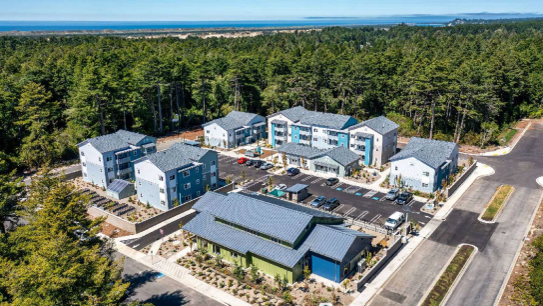
One man’s retirement passion project is bringing vital housing and childcare to the Central Oregon Coast.
Layne Morrill is a former tax and business attorney who transitioned into affordable housing development after relocating to rural Yachats, Ore., in 2005. Morrill saw a desperate need for quality low-income housing in the Pacific coastal town of 1,000 people, so in 2009 established the nonprofit affordable housing developer Our Coastal Village, Inc., hoping to use his professional background to uplift his new community.
“All along the Oregon coast, affordable housing is a huge problem,” Morrill says. “Employers were saying that there was no housing for the people who worked for them – that was the original impetus. I had observed some low-income housing projects being built and developed, and my background as a tax attorney and real estate-oriented transaction attorney had given me some perspective on it, so I decided to see if I could make it happen.”
Since its inception, the 501(c)(3) nonprofit has delivered two LIHTC-funded multifamily developments in Yachats and neighboring Florence (population 9,800): the 21-unit Fisterra Gardens Townhomes in 2019 and the 24-unit Oak Manor Apartments in 2023, as well as one development with no public funding, 2013’s Aqua Vista Square townhomes.
Morrill’s mission-focused work has now borne additional fruit with this past summer’s opening of the 32-unit Elm Park Apartments in Florence. The unique affordable housing community is co-located with the Elm Park Early Learning Center, providing vital childcare infrastructure on the same site as the affordable housing units. Elm Park Apartments celebrated its ribbon-cutting on August 27, though it has been near-fully leased up since mid-July
Transforming the “little forest”
The Elm Park projects came to life without the traditional use of federal Low Income Housing Tax Credits (LIHTC), instead leveraging Oregon’s Local Innovation Fast Track (LIFT) program for primary funding. Elm Park also benefited from other innovative local programs, including an infrastructure grant the City of Florence received from the state and a multi-unit property tax exemption.
“Public-private partnerships like this do not happen by accident,” Chantelle Meyer, Florence’s economic development and communications analyst, shared at the ribbon cutting ceremony (those remarks were later provided to Tax Credit Advisor via video recording). “They require leaders who know how to navigate changing laws, seize opportunities and push projects forward. Layne Morrill has done exactly that, moving quickly outside of government timelines while partnering closely with the city to ensure this project pencils out.”
Finding appropriate land was the deal’s first major hurdle.
Following the completion of Oak Manor (his first project in Florence), Morrill says he approached the city about building another low-income housing project, citing the ongoing need for quality affordable housing in the area. “But I couldn’t find suitable land,” he recalls.
In response, Florence identified several different parcels in the area they had targeted for housing development, including one that the city actually owned and was in the process of building infrastructure on with funding provided by Oregon Senate Bill 1530. This $1.9 million direct appropriation allowed Florence to build critical infrastructure for affordable housing on the untouched land, including water, wastewater, stormwater, street and sidewalk improvements. “It was in a totally underdeveloped neighborhood – it was a little forest,” Morrill says.
Located near a hospital, library, schools and public transportation, the parcel seemed like a perfect fit, and the city agreed to sell Morrill the land at market value, but with a 75 percent reduction upon completion of the mixed-use apartments and childcare facility on the site.
The reduced-cost sale was part of Florence’s nearly decade-long push to expand the town’s affordable housing supply, and city leadership sees childcare as going hand-in-hand with that effort. Florence, like many of its coastal Oregon neighbors, is designated as a childcare desert, meaning its supply of childcare providers meets less than a third of the demand. According to a 2024 report by Oregon State University, 34 of Oregon’s 36 counties are childcare deserts for families with infants and toddlers.
“A handful of years ago, we had several communities that were childcare deserts” says Andrea Bell, executive director of Oregon Housing and Community Services (OHCS). “People were in nearly impossible situations where either they were driving way too far just to be able to access affordable childcare, or the accessible childcare near them was way out of their budget.”
Prior to Elm Park, only 148 available childcare placements were available to the nearly 650 children living in the region, according to a 2025 re12ort from the city of Florence.
This lack of childcare access has acute effects on housing access, which in turn can imperil the long-term health of a community. “Our mayor has a wonderful saying: ‘You can’t talk
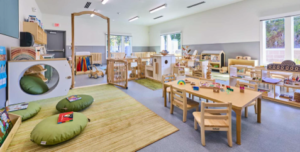
about affordable housing without talking about childcare,”‘ Meyer said at the ribbon cutting. “This project brings both of those things together in a beautiful way.” An interior view of the Early Learning Center. Courtesy Our Coastal Village, Inc.
Innovative financial framework
To make both the housing and the childcare work, Morrill separated the two projects into separate developments with unique funding sources and ownership. Our Coastal Village developed the apartments, while Chestnut Management – a separate entity also owned by Morrill – developed the childcare facility.
The main reason for this separation was to deal with prevailing wage requirements, which state-assisted commercial projects – such as the childcare center – must adhere to.
Affordable housing is generally exempt from Oregon’s prevailing wage requirements, although including commercial units will trigger the increased costs for the entire project.
The separation avoided the risk of losing the apartments’ prevailing wage exemption, allowing the deal to pencil. “To my knowledge, it’s the first time that has been done in Oregon,” Morrill says.
The developments were financed entirely by state and local-level funding sources.
Elm Park Apartments cost about $15 million to build, with an $11.8 million, 30-year, interest-free loan from the state of Oregon’s LIFT program covering the lion’s share of financing. The rest of the capital stack was built from a $1.85 million permanent loan provided by the regional Banner Bank, private donations, and direct investment from Our Coastal Village, Inc.
Elm Park Apartments shows the power of the LIFT program, which has provided critical funding to affordable housing projects in the state since its establishment in 2015. “It’s a
really flexible resource that allows for locally driven solutions to serve folks that have the lowest of incomes in our communities,” Bell says. Programs like LIFT “keep our communities going and make sure that people are not pushed out of the very places that they call home.”
The apartments consist of six one-bedroom, 16 two-bedroom, and 10 three-bedroom units. Ten units are set aside for households at or under 30 percent Area Median Income (AMI), four for households at or under 40 percent AMI, and 18 for households at or under 50 percent AMI.
Elm Park Early Learning Center cost $4.2 million, which was covered by a $2 million Oregon state childcare infrastructure grant, a $750,000 BuildUp Oregon grant for co-location of childcare with affordable housing, grants from several private foundations, and a $900,000 bridge loan from Our Coastal Village, Inc.
Both parcels benefited from Florence’s state-funded
infrastructure project, which allowed the developments to connect to the city’s water, wastewater, stormwater, streets, and sidewalks without needing to find funding for additional site work.
Although the bifurcated capital structure was unique, Elm Park represents a growing trend within the Beaver State to co-locate childcare and affordable housing. According to OHCS, Elm Park Early Learning Center is now one of nine OHCS-supported co-located projects.
A shining model
The childcare facility will be run by Head Start of Lane County and other community providers. Head Start is a 1960s-era federal program administered by the U.S. Department of Health and Human Services that supports local organizations in making no-cost childcare services available to very low-income families. Head Start only provides partial federal funding, meaning that organizations often need additional sources of state, local and philanthropic support in order to get operations running. Elm Park Early Learning Center will provide the space at significantly reduced cost, making it possible for Head Start of Lane County to operate at Elm Park Early Learning Center.
“Childcare is such a low-margin business that private operators can’t afford to pay market rent,” Morrill says. “The arrangement we have is that it’s basically a philanthropic project, and the only rent that Head Start and the other community providers have to pay is the real estate operating expenses: the taxes, insurance, repairs, and everything that a tenant in a triple net lease would have to pay, except they don’t pay any compensatory rent element to the landlord.”
Elm Park Early Learning Center consists of four classrooms. Two are for Head Start Programs for children age two to five. The other two are operated by a community provider serving infants (from six-weeks old), toddlers, and preschoolers. The facility accommodates about 70 children. It opened September 8.
The Early Learning Center was designed by Eugene, Ore.-based PIVOT architecture.
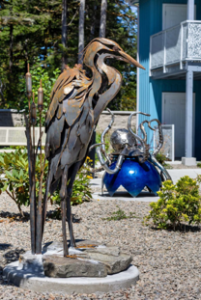
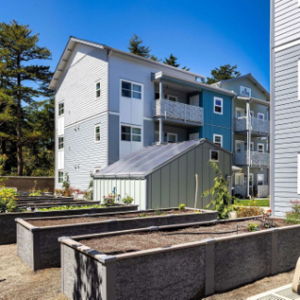
Bell commends Elm Park Apartments’ unique family-forward features – including a playground, outdoor gardening facilities and larger two- and three-bedroom units – that will complement the childcare facility. The development team also worked with two local arts organizations to select a handful of local artists whose work is featured on site.
Bell says Elm Park serves as a model, and hopes that other municipalities take note of Florence’s success.
“I think that there is a need for public bodies, for people in positions of responsibility, myself included, to ensure that we are not settling in mediocrity, but rather really figuring out where some of our systems need to transform, where some of our resources need to transform,” Bell says. “One of the things that we heard time and time again from listening to some of our small towns was that there was a feeling of excessive and elaborate bureaucracy that was difficult to get through, especially if you’ve got limited staff capacity. That was one of the reasons we streamlined our resource process.”
Absent dedicated state and funding, Morrill says childcare projects like this are not feasible.
“There is no commercial financing available,” he says. “The rent can’t cover any debt service, so it has to be a free and clear philanthropic project to make it work.”
Still, with state funding, teams can develop deeply impactful projects like this. “I hope that it can be replicated elsewhere because it’s an amazing thing to see,” Morrill says. “It’s an amazing thing that families with kids can walk across the parking lot to drop their kids off at childcare and even walk to work, because we’re located near the central business district.”
The site includes a shared garden space with outdoor raised beds and a greenhouse. Courtesy Brian Davies/Our Coastal Village, Inc.
infrastructure project, which allowed the developments to connect to the city’s water, wastewater, stormwater, streets, and sidewalks without needing to find funding for additional site work.
Although the bifurcated capital structure was unique, Elm Park represents a growing trend within the Beaver State to co-locate childcare and affordable housing. According to OHCS, Elm Park Early Learning Center is now one of nine OHCS-supported co-located projects.
A shining model
The childcare facility will be run by Head Start of Lane County and other community providers. Head Start is a 1960s-era federal program administered by the U.S. Department of Health and Human Services that supports local organizations in making no-cost childcare services available to very low-income families. Head Start only provides partial federal funding, meaning that organizations often need additional sources of state, local and philanthropic support in order to get operations running. Elm Park Early Learning Center will
provide the space at significantly reduced cost, making it possible for Head Start of Lane County to operate at Elm Park Early Learning Center.
“Childcare is such a low-margin business that private operators can’t afford to pay market rent,” Morrill says. “The arrangement we have is that it’s basically a philanthropic project, and the only rent that Head Start and the other community providers have to pay is the real estate operating expenses: the taxes, insurance, repairs, and everything that a tenant in a triple net lease would have to pay, except they don’t pay any compensatory rent element to the landlord.”
Elm Park Early Learning Center consists of four classrooms. Two are for Head Start Programs for children age two to five. The other two are operated by a community provider serving infants (from six-weeks old), toddlers, and preschoolers. The facility accommodates about 70 children. It opened September 8.
The Early Learning Center was designed by Eugene, Ore.-based PIVOT architecture.
Bell commends Elm Park Apartments’ unique family-forward features – including a playground, outdoor gardening facilities and larger two- and three-bedroom units – that will complement the childcare facility. The development team also worked with two local arts organizations to select a handful of local artists whose work is featured on site.
Bell says Elm Park serves as a model, and hopes that other municipalities take note of Florence’s success.
Local art, such as these sculptures by Giuliano Marchetti, are spread throughout the site. Courtesy Brian Davies/Our Coastal Village, Inc.
“I think that there is a need for public bodies, for people in positions of responsibility, myself included, to ensure that we are not settling in mediocrity, but rather really figuring out where some of our systems need to transform, where some of our resources need to transform,” Bell says. “One of the things that we heard time and time again from listening to some of our small towns was that there was a feeling of excessive and elaborate bureaucracy that was difficult to get through, especially if you’ve got limited staff capacity. That was one of the reasons we streamlined our resource process.”
Absent dedicated state and funding, Morrill says childcare projects like this are not feasible.